

$0.00


$100.00
Multi-layer shielding sheets that reduce magnetic field exposure from breaker panels, appliances, smart meters, and more!
Magnetic Field Shielding
Protect your home, office, or vehicle from unwanted magnetic field exposure with our Magnetic Shield Sheets — a professional-grade shielding material designed to reduce magnetic fields from wiring, appliances, and nearby electrical sources. Unlike bulky metal shielding, these ultra-thin sheets are built from multiple layers of shielding film bonded together, delivering better performance than a single thick sheet of metal, all in a lightweight, easy-to-install format.
Install them inside walls, floors, or ceilings during construction or renovation, or use them anywhere you want extra peace of mind — from home offices and bedrooms to RVs, vans, and electric vehicles. Whether you’re tackling one problem spot or an entire wall, Magnetic Shield Sheets offer a flexible, effective way to reduce your everyday magnetic field exposure.
Common Uses
When installing, be sure to overlap adjoining sheets by at least 1 inch to maintain continuous coverage. Testing with a Trifield TF2 meter on the Standard MAG setting before and during installation will help you determine how many layers you need as well as placement — lighter fields may only require a single layer, while stronger fields may call for 2–3 layers for adequate reduction.
⚠️ Safety Note: Sharp Edges After Cutting
Cut edges on this material are very sharp. We recommend measuring and planning your installation layout ahead of time to minimize how much cutting is needed. Any cut edges should be taped (duct tape works well) before further handling or installation.
Each laminated sheet is approximately 4.736121 sq. feet
Each sheet measures 80cm x 55cm or 31.5″ x 21.65″
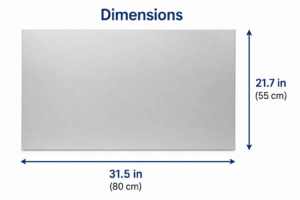
Area: .44 sq meters or 4.736121 sq. feet
Dimensions: 80cm x 55cm or 31.5″ x 21.65″
Thickness: 0.5 mm (0.7 mm overlap)
⚠️ Safety Note: Sharp Edges After Cutting
Cut edges on this material are very sharp. We recommend measuring and planning your installation layout ahead of time to minimize how much cutting is needed. Any cut edges should be taped (duct tape works well) before further handling or installation.
Only logged in customers who have purchased this product may leave a review.
Q: How do I know how many layers I need?
Testing with a Trifield TF2 meter on the Standard MAG setting before installation is the best way to determine this. Lighter magnetic fields may only require a single layer, while stronger fields may call for 2–3 layers to achieve adequate reduction. Sometimes a wider coverage area is more effective than multiple layers, which is why you need to use the meter during installation. We recommend testing again after installation to confirm the results.
Q: How much should sheets overlap when covering a larger area?
Overlap adjoining sheets by at least 1 inch to maintain continuous coverage. If you’re using multiple layers, stagger the panels so the overlaps in each layer don’t all line up in the same spot — this keeps the coverage more even throughout.
Q: What tools do I need to install this?
Wood screws, a power drill and drill bit, a measuring tape, a marker, and a metal-cutting tool (tin snips work well). If you’re installing on suitable substrates, an electric stapler or nailer is also an option — a mid-range electric stapler works for a single layer, while two or more layers require a professional-grade nailer. A Trifield TF2 meter is also considered essential for this installation — it’s the tool you’ll use to identify exactly where the magnetic field is coming from, confirm correct placement, and determine how many layers are needed. Testing before, during, and after installation gives you the best chance of getting full, effective coverage on the first try.
Q: Is it safe to cut?
Cut edges on this material are very sharp and must be handled with care. Plan your measurements in advance to minimize how much cutting is needed, and tape all cut edges (duct tape works well) before further handling or installation.
Q: Can I install this under drywall?
Yes — this is one of the most common applications. Once installed over studs, drywall goes on as normal. If you are installing multiple layers, you may need to use thinner drywall in the shielded area so the finished wall lays flush with the surrounding surface.
Q: Can I install this under flooring?
Yes. Affix the sheets to the subfloor with wood screws, following the same overlap guidelines. As with they drywall installation, if you are installing multiple layers, a thinner subfloor layer can be used if needed in the shielded area to keep the finished floor height consistent.
Q: Does this also block electric fields?
When properly grounded to your home’s grounding conductor, yes — this material can also help reduce electric field exposure. Each sheet includes a built-in conductive strip in one corner, making it straightforward to connect to a grounding tape or wire. Without grounding, it will only address magnetic fields, so proper grounding is essential if electric field reduction is also needed in that area.
Q: Can I use adhesive instead of screws or staples?
Yes, for certain substrates. Because of the material’s laminate surface, not all adhesives will bond to it reliably — an acrylate-based adhesive designed for this type of surface is recommended for a secure, permanent bond. Work in small sections when applying wet adhesive so you have time to make corrections, since dry adhesive bonds immediately and can’t be repositioned once set.
Q: Do I need a professional to install this?
Many customers install this themselves for smaller, targeted applications like behind a breaker panel or appliance. For larger installations spanning multiple rooms or requiring precise placement based on a shielding plan, working with your EMF professional or installer is recommended to ensure full, correct coverage.
Q: Can I use this under the entire floor in a room?
We recommend spot treatment only where needed since the beneficial earth fields can be dampened by this type of shielding material.
Reviews
There are no reviews yet.